Choosing office space in Bangalore isn’t just about location and budget — it’s about format. Pick the wrong one and you either overpay for flexibility you don’t need or lock yourself into capex you can’t justify. This guide explains the four main office types, what each really costs, and how to decide which fits your business in 2026.
The four formats, explained
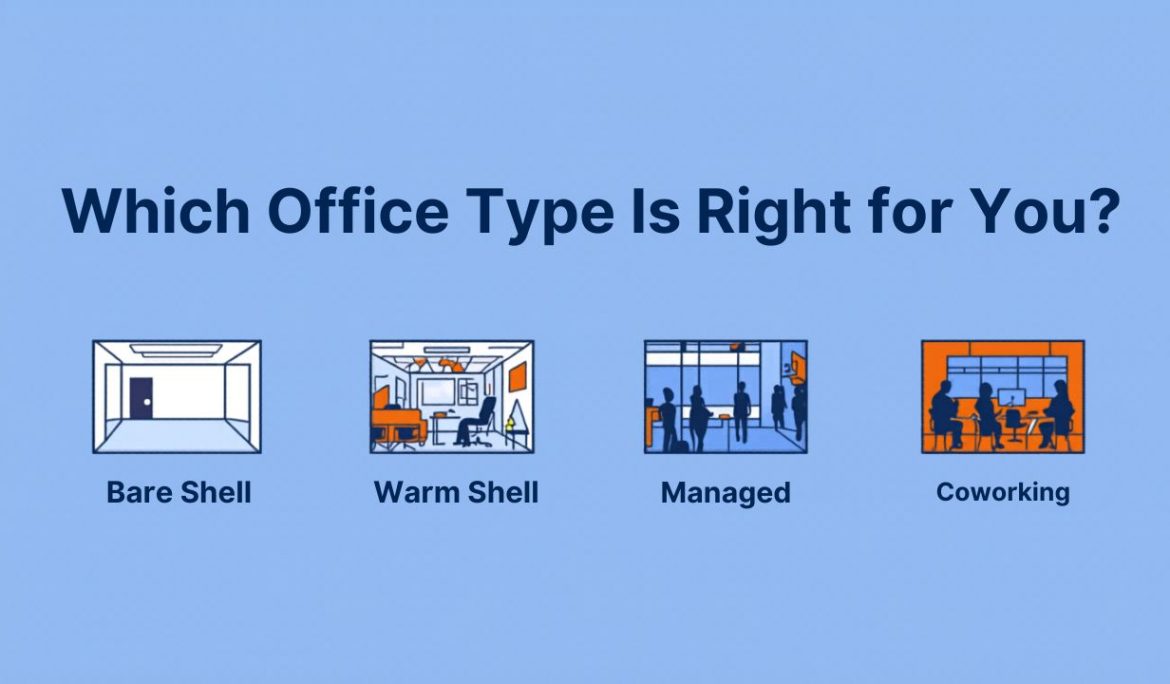
Bare shell is a raw space — bare floor, basic structure, no false ceiling, flooring, lighting, HVAC, or partitions. You design and build everything. It offers maximum customisation and the lowest headline rent, but demands the most time and upfront capital.
Warm shell is one step up: the landlord provides core building services — HVAC stub-ins, basic electrical, fire systems, sometimes flooring and ceiling — and you handle interiors and furniture. It’s a middle ground that shortens your fit-out without giving up design control.
Managed office is fully fitted and operated for you. The provider delivers a branded, ready-to-use office — furniture, internet, reception, housekeeping, security, and maintenance — and bills one all-inclusive amount per seat. You move in and start working.
Coworking is shared, on-demand workspace. You take desks or a private cabin in a larger facility and share amenities like meeting rooms, pantries, and lounges with other companies.
What each actually costs
The pricing models differ, so compare carefully:
- Bare shell: ₹45–₹150/sq ft per month depending on area and grade, plus a one-time fit-out of roughly ₹1,800–₹2,800/sq ft.
- Warm shell: Slightly higher rent than bare shell, but meaningfully lower fit-out capex since core services are in place.
- Managed office: ₹7,000–₹24,000 per seat per month, all-inclusive, with little to no capex.
- Coworking: ₹8,000–₹15,000 per desk per month.
The trap is comparing a ₹100/sq ft lease against a ₹15,000/seat managed quote as if they’re equivalent. The lease number excludes fit-out, furniture, utilities, and management; the managed number includes all of it. Always total the true cost of occupancy over your expected term before deciding.
Pros and cons at a glance
Bare/warm shell wins on long-term economics and brand control. If you’ll occupy the same space for years, amortised fit-out makes the per-month cost lower than managed. The downsides: heavy upfront capital, three to four months of project management, and you carry maintenance and operations.
Managed offices win on speed, flexibility, and zero capex — you can be operational in weeks and scale seats up or down without re-papering a lease. The trade-off is a higher recurring per-seat cost and less deep customisation. This is the fastest-growing segment in 2026, especially among GCCs and scaling teams.
Coworking wins on agility and community for small teams, with no commitment and instant setup. It becomes expensive per head once you cross roughly 20–30 people, and offers limited branding and privacy.
A simple decision framework
Match the format to your stage and certainty:
- Under 20 seats, early or uncertain: Coworking. Low commitment, instant start, networking built in.
- 20–300 seats, scaling fast, want zero capex: Managed office. Speed and flexibility outweigh the higher per-seat rate.
- 10,000 sq ft+, stable headcount, 3–5 year horizon: Warm or bare shell lease. Fit-out capex pays back over time and you control the design.
- Want lower capex than bare shell but still your own interiors: Warm shell — the pragmatic middle path.
Two more questions sharpen the choice: How certain is your headcount over the next 24 months? The less certain, the more flexibility is worth paying for. And how important is a fully branded, custom environment? If it’s central to culture or client visits, lean toward shell-and-fit-out.
The bottom line
There’s no universally “best” office type — only the best fit for your stage, certainty, and capital appetite. Startups and landing teams thrive in coworking; fast-scaling companies and GCCs increasingly default to managed offices; large, stable organisations get the best economics from a warm or bare shell lease.
If you’d like help running the numbers, we can compare real options across all four formats in your preferred Bangalore corridor — bare shell, warm shell, managed, and coworking — on a like-for-like total-cost basis, with negotiated rates and no brokerage fee.